


THE CANARY • THE REAL-LIFE POV
ACT 1: THE CANARY
THE G-D-P-R.
Four shiny white teeth. The General Data Protection Regulation (GDPR). Ferocious. Big tech DPOs (Data Protection Officers) lose sleep over them.
Introduced in 2018, this biblically vast EU regulation covers every scrap of personal data processing in existence—online, offline, public, or private. It is designed to prowl, ready to leap on any unsuspecting data controller not taking due care with data privacy.
When a data violation occurs, enforcement is handed over to the member state where the entity resides. That is because the GDPR contains over 50 open clauses allowing local customisation. If you are in Spain, for instance, the AEPD (Spanish Data Protection Agency) operates like an active dragnet, hauling in thousands of domestic businesses and tech platforms alike. (See my inquiry on why Spain’s paper dragon racks up 1,079 enforcement cases while Finland stays at a quiet 27—it’s a regulatory blood sport)
But what happens when we deal with platforms that are omnipresent—spread uniformly across all EU member states? As much as local regulators might relish taking a swing, we cannot have every national agency fining global tech giants left, right, and center. Imagine twenty-seven different national agencies launching independent investigations and issuing conflicting penalties for the exact same violation. That would be an administrative civil war.
Instead, under GDPR mechanisms, tech giants are regulated primarily by the country where they maintain their European headquarters. For structural and tax reasons, that headquarters is almost always tucked away in Ireland or the Netherlands. This quirk creates a brilliant illusion. Because the Irish Data Protection Commission (DPC) holds the penalty pen for Meta, TikTok, and LinkedIn, the resulting fines get dumped straight into Ireland’s national ledger. Look at the aggregate GDPR fine tracker, and Ireland towers over the continent, boasting over €4 billion in total fines, with the Netherlands trailing not far behind. Put another way: of the fifteen largest GDPR fines on record exceeding €100 million, a staggering majority—9 in 15—stem directly from Dublin’s desk (more details in the data cage below).
These blockbuster fines regularly dominate the headlines. Only a few weeks ago, a classic piece of political theatre crossed my screen during a quick coffee scroll: a clip of Mark Zuckerberg facing down Senator Dick Durbin during the 2018 Senate hearings following the Cambridge Analytica fallout.
The senator’s trap was beautifully simple. He asked Zuckerberg if he would care to share which hotel he stayed in the previous night, or a list of everyone he had texted that week. Zuckerberg demurred, smiling tightly—the exact point the senator was driving home. Private data is power, and corporate feeders should be kept at bay.
The result? Meta copped a $5 billion penalty from the US Federal Trade Commission in 2019. On paper, it looked like a massive win for consumer protection.
Except, let us look at the scoreboard. For a tech monopoly, regulatory fines are not punishments; they are line items factored into their operating budgets. It is the cost of doing business. That $5 billion fine was historically massive on paper, but financially painless for Meta in reality. It amounted to roughly 9% of Meta’s total revenue for 2018. With a net income of $22.1 billion that year, the fine left them still with a fluffy cushion of $17.1 billion in profit. Score: Regulators 1, Meta 0.
Did a multi-billion-dollar penalty alter their risk assessment for data play? Not for a second.
Hold onto your teacup. Exactly five years later, European regulators caught up with them for another structural violation—landing them another record: the highest GDPR fine in European history.
Yup, €1.2 billion this time. Lesson, as it turns out, entirely unlearned. Draw your chairs. Welcome to the pantomime.
The €1.2 Billion Irish Pantomime
SCENE 1 — Mr. Smith and the Data Pipe
Let’s set the scene with our resident Mr. Smith.
He is at his screen, typing out a comment on his friend Mikey’s Facebook page. But the moment he hits post, he realises he can suddenly see right through his monitor: a yawning, great big glowing pneumatic tube is bursting out of the back of it and crashing through his living room wall, sucking up his digital footprint with the force of a jet engine.
As he stares, he watches his 1s and 0s get sucked down, twisting and turning, branching off into subterranean forks, until—plop!—they pop out into the bright American sun in front of a munching server-cow.
You see, when he registered his account years ago, his profile, his friend network, and his accumulated personal history and messages were vacuumed across the Atlantic and dumped into a sprawling, surreal pasture: massive American server farms populated by mechanical server-cows. And boy, are the cows hungry. Every time he does anything on FaceBook, Meta’s centralised global pipelines shovel it straight to them. What is more, do not imagine his personal data is neatly filed in one tidy folder—it has been chewed up, digested, and scattered across multiple digital stomachs from Virginia to Oregon.
To Meta, moving data globally is just how the internet works and also how their software is built. Their global databases constantly shard, reindex, and mix user data across borders. To the EU, however, that continuous, systemic pipeline wasn’t just quirky farming—it was a major legal violation. Not because data was flying across borders, but because of one particular border it was crossing: the United States.
And that brings us to the real-world fence around this digital pasture: FISA Section 702. Or, to you and me, the legal rule that allows US intelligence agencies to tap into the digital communications of non-US citizens living outside America without a warrant.
So, while Mr. Smith’s data-grass is being happily munched on by American server-cows, the local surveillance farmer has full permission to peer over the fence and check what they are eating.
Moo.

— Mr Smith and the data pipe
SCENE 2: Max, Snowden, and the Ten-Year Trench War
2011: Enter Max Schrems, an Austrian law student (now chairman of NOYB—None Of Your Business) who asked Facebook for a copy of all his personal data. A physical CD arrived containing 1,200 pages of deep behavioural tracking. It included all his personal messages (even deleted ones), a record of every event he had ever attended, every click he had ever made—and imagine, he had only had the account for three years. Realising EU citizens had zero legal protection against US data harvesting under the weak “Safe Harbour” agreement, Schrems launched europe-v-facebook.org.
2013: The escape hatch blows wide open. Edward Snowden leaks the NSA’s PRISM program, exposing the reality that US tech giants were legally required to provide backdoor keys to intelligence agencies under FISA Section 702. The big tech companies claimed they had absolutely no idea it was happening. Really?!
So, armed with a smoking gun proving why sending data to US servers violated European fundamental rights, Schrems marches down to the Irish DPC and files an official legal complaint on June 25, 2013.
The Irish DPC—who preferred their big tech giants cozy and undisturbed—promptly dismissed it, insisting they had no jurisdiction over Schrems’ complaint and pushing it aside. Rightly so, Schrems dragged them through the Irish High Court, which bumped the question straight up to the Court of Justice of the European Union (CJEU).
You see, for years, cross-border data flows had limped along on administrative life-support. First came Safe Harbour—a voluntary pact where US tech giants promised they would self-certify that EU data was free from spying and that privacy rights were upheld. When Max’s challenge forced the CJEU to inspect its innards, the court was horrified to realise the framework was powerless against US intelligence agencies. Result: Safe Harbour was killed in 2015, and the landmark ruling was named Schrems I.
Not to be deterred, politicians cooked up a sequel: Privacy Shield in 2016. It added a bit more bureaucratic lipstick to the cow—including an empty promise of an independent ombudsman (turns out, not so independent after all) for EU citizens to complain about US spying. But signing a piece of paper couldn’t change the hard reality of US federal law (FISA 702), which legally compelled tech giants to hand over data to Uncle Sam. With the US surveillance engine roaring louder than ever, Privacy Shield flopped, and the CJEU struck it down in July 2020 with the monumental Schrems II judgment.
With both pacts down the drain, big tech companies and businesses that relied on transatlantic data flows had to scramble. The only lifeline left was Standard Contractual Clauses (SCCs). These are pre-approved, company-to-company legal contracts drafted by the European Commission that a European business and its foreign partner must sign, promising that privacy protections will follow the data across the ocean.
Under Safe Harbour and Privacy Shield, the frameworks were government pacts that sheltered US big tech, letting them shout, “But Uncle Sam told us it was fine!” With SCCs, that cozy shield vanished.
Except this time, under Schrems II, the rules changed entirely. Companies couldn’t just sign the paperwork, file it away, and kick back. The legal liability landed squarely on their shoulders. They had to assess destination laws and add supplementary technical safeguards—like heavy-duty encryption where only the EU company holds the keys. If local surveillance laws conflicted with EU privacy and couldn’t be bypassed with tech, they were legally required to pull the plug. The contract could no longer be a legal lie; it had to be actionable paper.
So let us swing back round to Meta. How were they doing with their SCCs? They completed the forms and filed them nicely away. But that is where it stopped. There was zero action to check local laws or implement snooping protections. They just kept sucking data across the Atlantic into server farms under Uncle Sam’s watchful eye, violating both their own private contracts and the GDPR.
Here is the kicker: of course the CJEU knew what tech giants like Meta were doing. Everyone in Brussels, Ireland, and Silicon Valley was doing the exact same thing. SCCs were the worst-kept open secret in the entire tech industry.
The catch is that the CJEU is a passive referee—bound by ne ultra petita (no action, no court), it cannot launch its own investigations. It had to wait for a case to be dragged to its doorstep (Schrems II was exactly this). So, when it ruled that local regulators must step in and suspend transfers when mass-surveillance laws conflict with EU privacy, the reluctant Irish DPC was finally cornered.
Frustrated by Dublin’s decade of defiance, the rest of Europe had said: Enough is enough.


THE ONION • THE OFFICIAL SPIN
ACT 2: THE ONION
SCENE 1 — The Cozy Concierge of Dublin
Let us swing back to Big Tech’s cozy concierge: the Irish DPC. Critics like Max Schrems had long accused Dublin of acting more like a protective corporate mother hen than an aggressive law enforcement agency. While other European regulators were eager to draw their swords, the Irish DPC repeatedly dragged its feet, dragging out investigations for years and favouring “amicable resolutions” behind closed doors rather than dolling out fines. After all, they had spent decades cultivating a business-friendly, low-tax environment. Aggressively cracking down on Meta felt less like policing and more like choking the golden goose.
The Irish DPC’s formal investigation finally took off in August 2020. But it quickly became clear that the “softly softly” approach was still their weapon of choice.
Enter the European Data Protection Board (EDPB)—the overarching watchdog uniting the heads of every national data protection authority across the EU. They were watching, and they quickly moved to stop Dublin from watering down the ruling. Armed with Article 65 of the GDPR, the EDPB has access to the red nuclear button: when a reluctant lead national authority tries to soft-pedal a case, they can step in, overrule them, and force binding decisions. And step in they did.
Publicly, the Irish DPC played it cool, calling it “healthy regulatory divergence,” but behind closed doors, it must have been a stinging institutional humiliation.
On May 22, 2023, the hammer finally dropped. After nearly three years of investigation, EDPB Chair Andrea Jelinek laid down the law:
“The EDPB found that the infringement is very serious since it concerns transfers that are systematic, repetitive and continuous.”
—Andrea Jelinek, EDPB Chair (22 MAY 2023)The ultimate irony of the whole pantomime? The enforcement action carried a brutal sanction trifecta: A €1.2 Billion Fine (the largest GDPR penalty at the time), A Suspension Order to put a stop on all future unauthorised data transfers across the Atlantic, and A Repatriation Mandate giving Meta just six months to either bring back or delete all EU user data residing on US server farms.
And where did that record-shattering €1.2 billion windfall land? Straight into the national ledger of the very country that tried hardest to prevent it. As Max Schrems dryly pointed out:
“It took us ten years of litigation against the Irish DPC to get to this result. We had to bring three procedures against the DPC and risked millions of procedural costs. The Irish regulator has done everything to avoid this decision but was consistently overturned by the European Courts and institutions. It is kind of absurd that the record fine will go to Ireland—the EU Member State that did everything to ensure that this fine is not issued.”
—Max Schrems, noyb.eu (22 MAY 2023)And even then, the Irish DPC went soft on the total figure. Under the GDPR, the maximum statutory penalty a company can face scales up to 4% of its global annual turnover. With Meta’s full-year turnover hitting $116.61 billion, the maximum legal limit could have easily smashed past $4 billion for a decade of knowingly breaking the law for profit.
Instead, the Irish regulator opted to fine Meta considerably less than it could have—while still landing a figure a lot larger than it ever wanted to write.
The mother hen was forced to kick her favourite chick out of the nest anyway.
“It took us ten years of litigation against the Irish DPC to get to this result. We had to bring three procedures against the DPC and risked millions of procedural costs. The Irish regulator has done everything to avoid this decision but was consistently overturned by the European Courts and institutions. It is kind of absurd that the record fine will go to Ireland—the EU Member State that did everything to ensure that this fine is not issued.”
— Max Schrems, noyb.eu (May 22, 2023)
Incident Dossier • Transatlantic Data Freeze
SCENE 2 — Unscrambling the Data Omelette
Sure, Meta had to cough up €1.2 billion—which, let us be honest, is still just the cost of doing business. But the real panic was the repatriation mandate: the order to delete or haul back all EU user data to European data centres, and secure the privacy angles on ongoing flows or stop transfers altogether. Suddenly, the entire business model looked terrifyingly fragile.
The fundamental problem for Big Tech is that seamless data movement is their lifeblood. Without it, the entire global cloud architecture fractures. As Meta executives Nick Clegg and Jennifer Newstead warned in their official May 2023 response:
“Without the ability to transfer data across borders, the internet risks being carved up into national and regional silos, restricting the global economy and leaving citizens in different countries unable to access many of the shared services we have come to rely on.”
—Nick Clegg and Jennifer Newstead, President of Global Affairs & Chief Legal Officer, Meta (22 May 2023)Translation: Please panic with us, because our entire business model depends on moving data seamlessly across borders.
Because European user data doesn’t sit neatly in a single tidy folder. As we saw back with Mr. Smith’s data-grass, it has been chewed up, digested, and shredded across a sprawling maze of multi-region servers and data centres—turning personal information into a scrambled data omelette. Complying meant trying to re-engineer an active, hyper-complex digital architecture on the fly.
As tech analyst Carmi Levy put it, it was like trying to “re-engineer a plane mid-flight.“

—Mr. Smith re-engineering the DATA plane mid-flight
SCENE 3 — Farcical Timing (€1.2 Billion vs. 8 Weeks)
What really mattered to Meta was keeping the transatlantic data pipes wide open. If those stopped, the entire digital empire grinds to a halt. But if you thought they were about to radically redesign said empire, you’d be wrong.
Just eight weeks after the Meta ruling in May 2023, the political machinery in Brussels and Washington pulled off their most astonishing magic trick yet.
They patched together a brand-new diplomatic deal, boringly named the EU-US Data Privacy Framework (EU-US DPF). It was the third official attempt to patch the transatlantic data pipe, following the spectacular, smoking crashes of Safe Harbour and Privacy Shield.
This is where the farce lies. President Joe Biden and European Commission President Ursula von der Leyen had already mapped out the handshake back in March 2022—more than a year before Meta was even fined. They drafted a fresh adequacy decision declaring that, actually, the US did ensure an adequate level of data protection this time around.
So, Meta was facing a triad of penalties and impossible changes to implement—only for it to suddenly become fine again under another shiny piece of paperwork (which critics noted was an almost carbon copy of the failed Privacy Shield). What was illegal, systemically flawed, and dangerous in May suddenly became completely fine by July.
Did the new policy actually satisfy the GDPR? Yes, it has… oh, wait, no it hasn’t, oh yes it has… in line with the classic panto singery. If you’re in the “yes” camp, it gave Big Tech the exact legal breathing room they needed to survive. Meta signed up almost instantly on September 7, 2023, before the ink was even dry, and went right back to business as usual, relying on the EU-US DPF to keep the data pipes wide open.
If you’re in the “no” camp, well, you’re with Max and many others who are stewing all over again. Fresh challenges against the EU-US DPF were launched immediately. As Meta executives Nick Clegg and Jennifer Newstead pointed out in their defense:
“This is not about one company’s privacy practices—there is a fundamental conflict of law between the US government’s rules on access to data and European privacy rights, which policymakers are expected to resolve.”
—Nick Clegg and Jennifer Newstead, President of Global Affairs & Chief Legal Officer, Meta (22 May 2023)And if you thought the ink on the EU-US DPF was finally dry, think again. The legal ground underneath it just blew up. Again. On 29 June 2026, the US Supreme Court ruled that the Federal Trade Commission—the agency designated to police EU data protection for the EU-US DPF—is not actually independent because its commissioners can be fired at will by the President. And since EU law strictly demands an independent regulatory watchdog, the EU-US DPF’s entire legal foundation has been detonated

THE OPEN DOOR • QUIET AGENCY
ACT 3: THE OPEN DOOR
Well, it is certainly time to make our exit from this panto. What we are all watching is a high-stakes, multi-billion-dollar game where everyone repeats the exact same steps, knowing the underlying foundation is broken. It is utterly absurd, yet impossibly complex to fix.
The US is never going to drop FISA Section 702 to mollify EU privacy demands. It remains vital to national security—accounting for roughly 60% of the intelligence in the President’s Daily Briefing to foil terrorist plots and drug trafficking. Conversely, the EU is never going to back down on its foundational charter protecting citizens from foreign state surveillance. It is a grinding, irreconcilable legal clash. And with FISA 702 recently renewed and expanded by Washington, the EU-US DPF is a dead duck in the water. Because the European Commission declared the new Data Privacy Framework ‘safe’ in 2023, Meta is legally allowed to keep transferring data today. It completely pauses the Irish DPC’s order to delete European user data, even though everyone knows this new framework is facing the exact same legal cliff.
As for Meta and its €1.2 billion penalty, the whole ordeal feels less like regulation and more like corporate seppuku. There is a profound irony in fining a company for moving data across borders when modern cloud architecture was engineered precisely for global flow. Asking Meta or any hyper-scale platform to keep European data locked in a strict geographic silo is like trying to unbake a cake. It breaks the economic and operational model of the internet: duplicating infrastructure, blowing up cloud costs, killing global indexing, and degrading critical systems like anti-money laundering programs (AML) and fraud detection.
Yet, big tech isn’t out to get us; they are simply trapped inside the same global river. When Microsoft fought a US warrant demanding customer emails stored in Ireland, citing local sovereignty, it proved they often just want their architecture to function without running interference for intelligence agencies.
And the futility of the fine punishes a private corporation for a deadlock created entirely by governments. And realistically? Meta isn’t paying it. In fact, of all the top-tier GDPR fines listed across Europe, not a single one has been paid—every single one is locked in protracted appeals.
Adding to the plot twist, the CJEU recently opened a direct legal escape hatch allowing companies like Meta to challenge the EDPB directly, offering a clear shot at wiping out the penalty entirely—much like Amazon’s massive €746 million fine that got annulled in March this year.
The ultimate irony? Meta is currently using the brand-new, equally dodgy EU-US DPF as a legal shield to bypass the very orders meant to punish them for violating the old framework. While this framework keeps the data pipes open, the underlying legal cliff approaches.
When the €1.2 billion penalty arrived in May 2023, Meta didn’t scramble to pack up its servers or restructure its empire. Instead, they did what any seasoned tech titan does: they formally appealed the decision. This triggers a legal block. The fine and legal deadlines are frozen, pending the outcome of the court battle. So the fine and all its past infractions are locked away. As at the time of writing, the appeal still crawls through the courts, the fine remains uncollected, and with Meta now signed up to EU-US DPF, the data pipes never missed a drop. Meta stayed right where it was: business as usual, humming servers, fields of glowing server-cows—and a deeply puzzled Mr. Smith back in his living room, watching his data grass fly across the Atlantic for the umpteenth time.
The pantomime hasn’t ended. Take a break everyone and grab popcorn for Schrems III.
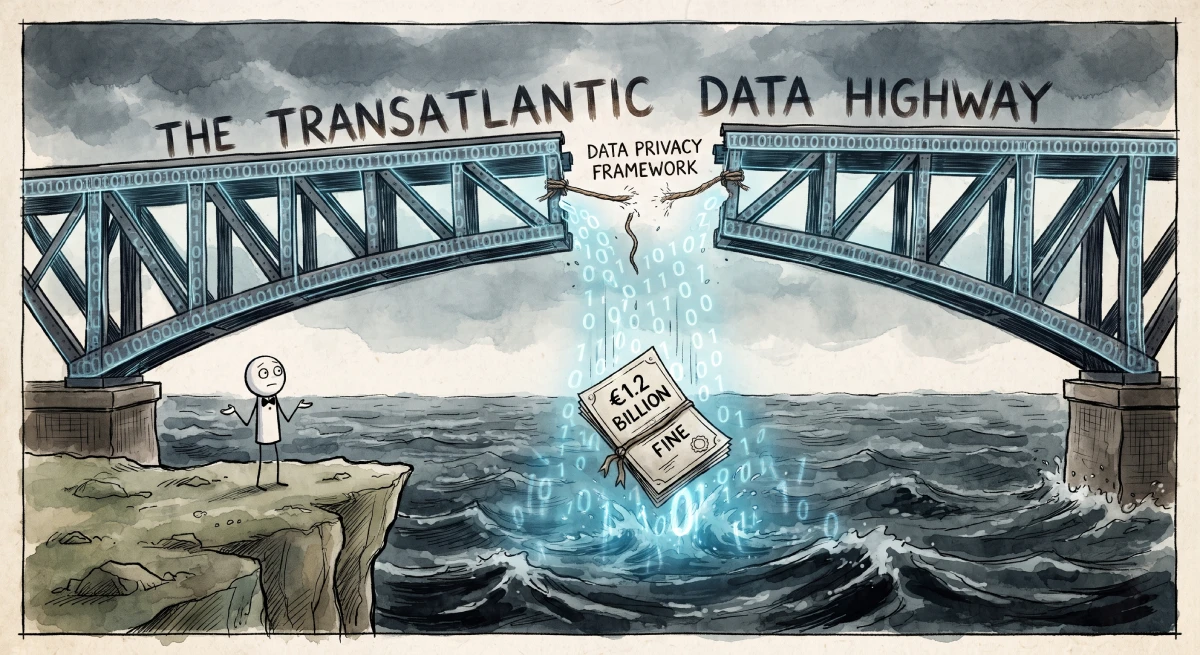
— The Transatlantic Data Highway: held together by a prayer, a fraying piece of twine, and a lot of wishful thinking.
Over to you
This post just happened off the back of my recent inquiry into Finland and Spain’s AEPD—where we tracked how radically different national laws and cookie-blocking habits shape the digital landscape—and it turned out to be such a fascinating side spin into transatlantic data freezes and regulatory dogfights that I simply had to follow it before leaving the GDPR maze behind.
I love how every time I write these pieces, it’s an exercise in discovery—I genuinely enjoy unravelling all the moving parts. I don’t pretend to be anyone special; I certainly don’t work inside Big Tech, and I’m no privacy lawyer or data watchdog.
When you read the daily GDPR headlines, it’s so easy to grab an off-the-shelf, quick opinion because everything looks deceptively simple on the surface. It’s a subject that demands a bit of a shovel to unearth the nuggets in play before a homegrown opinion can take root. Deep waters run smooth, as they say, and navigating a landscape this deep makes it remarkably easy to get tripped up. As someone who loves a deep dive like this, I’m still naturally bounded by my current vantage point, which means it is easy to view the data through a single lens and miss the bigger picture.
If I’ve skewed a metric or completely missed an angle that shifts the entire perspective, please tell me down in the comments below. It would be fascinating to uncover a few more onion layers.
 PUBLIC POLL • WHAT’S YOUR VERDICT?
Can Big Tech realistically afford to repatriate and isolate European user data without breaking their business model?
Cast your vote.
👥 0 votes recorded so far
 OFF THE RECORD • UNTRACKED
THE DISPATCH DROP —
Slip Me a Lead
Heard an official figure that sounds like nonsense on the ground? Drop it here. I’ll check the records—if it’s solid, it becomes my next post.
Stored locally in my queue. I never record IP addresses or digital fingerprints.
Primary Sources & Documentation
The Dossier
[ Click to Inspect ]
 ↓
↓
The Dossier
[ Click to Inspect ]
↓
The Canary (Regulatory & Legal Frameworks)
- Safe Harbour Collapse: The Guardian on CJEU Safe Harbour Ruling Coverage of the landmark 2015 European Court of Justice ruling striking down the original transatlantic data transfer pact.
- Privacy Shield Overview: IAB Europe Framework Summary Breakdown of the short-lived successor agreement that was ultimately dismantled by subsequent Schrems litigation.
- EU-US Data Privacy Framework: Program Overview & Adequacy Decision The third-generation administrative pact designed to bridge EU data protection standards with US intelligence statutes.
Decisions & Responses (Regulatory & Corporate)
- Irish DPC Decision: Official Press Release (€1.2B Fine) The primary regulatory notice detailing the €1.2 billion fine and compliance order issued against Meta Platforms Ireland.
- EDPB Binding Decision: Decision 1/2023 on Meta Platforms Ireland The formal Article 65 dispute resolution document adopted by the European Data Protection Board overriding Dublin’s foot-dragging.
- Meta Official Response: Corporate Statement on EU-US Data Transfers Meta’s corporate statement authored by Nick Clegg and Jennifer Newstead regarding their planned legal appeal and operational continuity.
The Onion (Historical Precedents & Scandals)
- Max Schrems Profile: The Independent Profile on the Privacy Champion Early biographical feature tracking the Austrian law graduate’s emergence as a relentless thorn in Silicon Valley’s side.
- PRISM Leak: The Guardian Report on NSA Data Mining The foundational Edward Snowden disclosures exposing mass US intelligence surveillance programs operating through tech giants.
The Raw Ledger (Datasets & Enforcement Trackers)
- CMS Enforcement Tracker: EU-27 Consolidated GDPR Sanction Register Total enforcement actions, cumulative fines, and analytics tracking platform.
- Tracker Analytics: Enforcement Analytics & Statistics Portal
- FISA Section 702 & Oversight: US Intelligence Fact Sheet & Congressional Research Report
DEEP READING (Supplementary & Commentary)
- noyb (European Center for Digital Rights): noyb.eu Official Portal Primary digital repository for Max Schrems’ ongoing strategic privacy litigation and enforcement tracking.
- Data Localization Risks: TrustArc Global Localization Study Analysis of corporate structural shifts toward regional data residency.
- Sovereignty Precedent: Columbia Global Freedom of Expression Legal analysis of cross-border data warrants and extraterritorial jurisdiction.
- Industry & Tech Analysis: IAPP Coverage & TechCrunch Analysis Professional commentary on the immediate fallout and global technical implications of the ruling.
- Carmi Levy: Independent Technology Analyst & Journalist. LinkedIn Profile
The Commentary

Pick your battlefield down in the comments below:
- The Enforcement Question: Is a record-breaking GDPR fine that never gets collected a legitimate deterrent, or just expensive regulatory theater?
- The Framework Question: How long before the EU-US DPF hits its next legal cliff, and what happens when the paper bridge finally snaps?
Zero cookies, no accounts, and no tracking. Drop a thought or story below.
Leave a Reply