
 The Glass Cage
I keep saying most websites don’t need a cookie banner. Saying it isn’t enough. So I put my own site’s numbers in a glass cage and left the door open.
1 · The problem
For years we’ve been told every website needs a cookie banner, so often that it feels like the law. I truly believe most of them don’t.
Then there are the banners themselves. I have a feeling a lot of them are copied from another site or pulled from a template, and plenty don’t even meet the rules they’re supposed to follow. Add the dark patterns: one big bright “Accept all”, and “Reject” buried three menus down.
People should feel empowered online: informed, and never tricked or sidelined. But we’ve all got busy lives, and nobody can be an expert in everything. So most of us just go along with the trend. Website owners too. With so many banners getting it wrong, I think plenty go up just so someone can say it’s been done. And it’s shooting yourself in the foot. The site slows down, the reader gets annoyed, and the casual browser, the one just having a look around, gives up before they’ve even arrived.
So I build sites without the banner. Fast, funky, lean and mean: pages that load in a blink, score well on Google’s speed test and don’t jump about as they load. No tracking cookies, and no grey wall before you’ve read a word. Just an honest site that respects the reader. It feels better, and I think it earns more respect, from readers and from the people who might one day hire me.
There’s a catch, though: anyone can say that. Why should you believe me? I can tell you. Or I can show you.
2 · What I built
So I’m showing you. I built a back door into this site and left it wide open: the Glass Cage. Step in, have a peek, and see exactly what I can see. Every statistic I have, how fast the page loads for you, which plugins I use, even how many of my visitors are robots rather than people. I haven’t seen many sites do that, so here’s my go.
It’s the real world, and a lot less glamorous than the headlines. This site is a baby, and you can watch it grow up alongside me. I’m not ashamed of that. It’s how every website starts, and I don’t need to fake the numbers.
Behind the glass, it’s one home-made must-use plugin. Once a day it asks Cloudflare for the totals with a read-only key, keeps them, and draws them as tables and charts. Anything smaller than five gets folded into “Other”, so nobody can be picked out of a row of one. Here’s what’s on show:
- Your visit, just now. Time on the page, how far you’ve scrolled, tab switches, where you came from, your device. All in your browser, sent nowhere.
- Your fingerprint. What those details add up to, and how other sites use them to recognise you, no cookie needed.
- The cookie jar, and the jelly. Every cookie I give you, and which kind would need your yes. Plus the browser notes I call jelly.
- Everyone’s visits. Pages viewed, how people found the site, devices, browsers and countries.
- The busy hours. Commuter rush or working hours? It tells you a lot about your readers.
- Robots vs readers. What the server answered, against what people actually opened.
- The speed test. Load time, page weight, files fetched, and any code from other companies.
- Under the bonnet. Every plugin, home-made ones included, plus a CSV anyone can download.
Then there’s the part I think matters most: what I don’t know about you. Whether you’ve been here before. Where you go next. Which ads you clicked. Who you are.
That’s what site owners think they’re missing without a banner. They aren’t missing. They’re intrusive. You shouldn’t want them, and most sites don’t need them.
What’s left is plenty. So ask yourself: hang on, do I actually need a cookie banner? Why can’t my site be lean like this, without a pile of plugins making it fat and slow? That’s the whole point. I build sites people enjoy using. Fast, lean, respectful. Good for your readers, and good for you.
3 · What surprised me
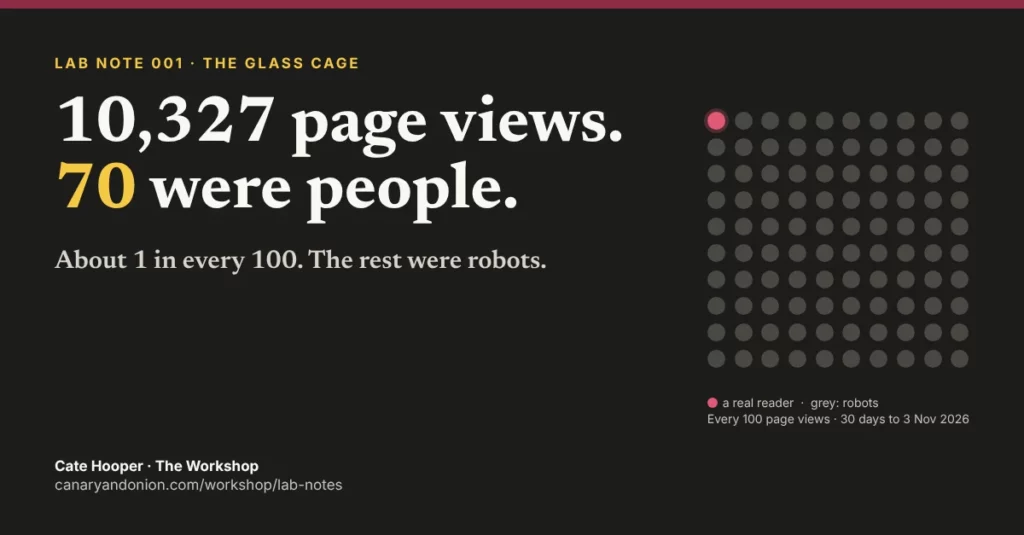
The server and the readers told two very different stories. In 30 days the server answered 42,713 requests and counted 10,327 “page views”. Real people, in real browsers, opened 70. That’s 148 robots for every reader. I honestly had no idea how much serving a server does. It really lives up to its name.
Which makes me wonder: how much of that is any use to anyone? Are the same bots doing the same journeys over and over? How good are they at whatever they’re after? That’s a Lab Note for another day.
All these numbers come from Cloudflare, which was new to me too. It sits in front of my site like a shield and a shortcut. Visitors reach Cloudflare first, and it passes on the real traffic, helps keep the troublemakers out, and serves pages from somewhere near you so they load faster. I chose it because it’s free, it guards the door, and its counter doesn’t need a single cookie.
The second surprise: Cloudflare’s free counter writes down about one visit in ten, then multiplies by ten. It handles a mind-boggling amount of traffic, and keeping every single visit would make its reports slow and expensive. So 3 real readers can show as 0 one week and 10 the next. My little site jumps about, and that’s fine. I say so right under the chart. This is a learning curve for sure.
4 · The receipts
the real numbers, straight through the open door
- 70 page views by real people in 30 days (views, not different pages: opening the homepage twice counts twice. And it’s Cloudflare’s estimate, from about 7 recorded views, times ten)
- 0.52 s ready to read, timed on my laptop (Google counts anything under 2.5 seconds as good)
- 1.5 MB page weight, about half a typical page
- 0 extra plugins to build it (the whole site runs on just two: Safe SVG, so I can upload SVG images safely, and Slim SEO, for share cards and search. More in Note 011)
5 · What I’d do differently
I’d probably have given my web-building its own website, away from Canary & Onion. Right now the publication and the Workshop share a roof, and I feel the pull both ways. But this is my living lab. I test everything here first, in public, so that what I tell clients is true, and so you can watch me get things wrong and find quicker ways. For now, the black Workshop bar is my compromise: one house, two front doors.
6 · What this means for your site
You can know how your site is doing without a cookie banner. Totals, not people. And if you’re proud of your numbers, you can even show them.
The spec sheet
File
canary-glass-cage.php
Data from
Cloudflare Web Analytics, read-only key kept in wp-config
How often
Once a day, then cached
Privacy rule
Any row under 5 becomes “Other”
Plugins added
None
Built with
PHP, native blocks, a lot of tea, and Claude as my pair programmer