
 The Glass Cage
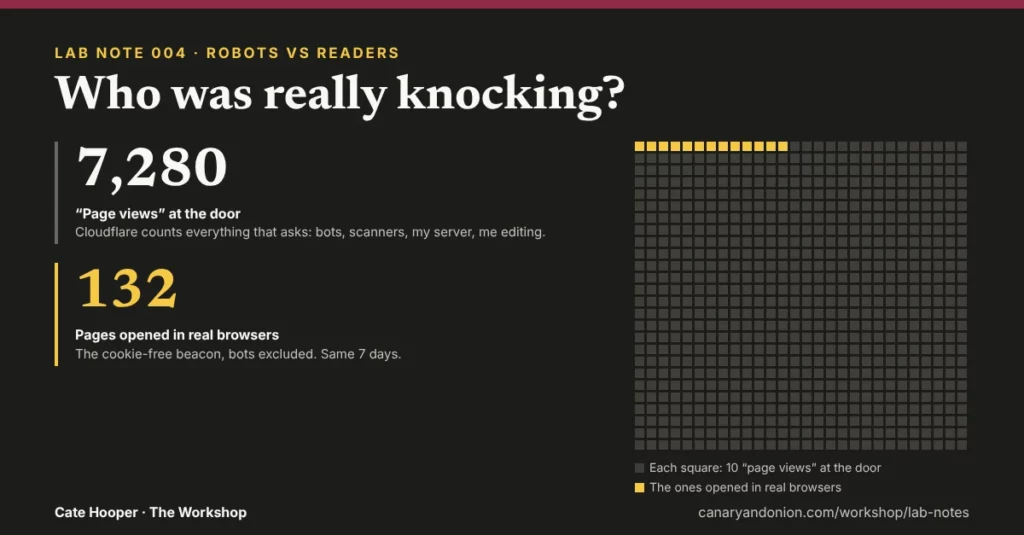
Last week, Cloudflare counted 7,280 “page views” at my door. Real people, in real browsers, opened 132. So who were the rest?
1 · The problem
When I first saw the robots against the humans, I was shocked. I knew there were a lot of bots out there, of course. I just didn’t realise there were quite so many.
It’s not completely deflating though. Traffic that isn’t people isn’t automatically bad.
Bot or robot?
Same thing. “Bot” is just short for robot: a program that visits websites on its own, with no person clicking. Some are helpful, some are nosy, and some are up to no good:
- Helpful. Search engines like Google and Bing, reading my pages so people can find them. And link previews: when I paste a link into LinkedIn or a chat app, a bot fetches the page to build that little preview card.
- Nosy. AI crawlers, collecting pages to train or feed AI tools. Whether I let them in is my choice, and Cloudflare has a setting for it.
- Up to no good. Scanners and login-guessers, trying doors to see if one has been left unlocked.
2 · What I set up
Nothing on my site this time. Everything happened at Cloudflare’s door.
On the morning of 30 October, I opened my analytics: 2,110 requests in a day, and 1,930 of them came from Canada, every one hammering my login page. Not a crowd of Canadians. One script, guessing passwords.
So that same morning I set up one security rule, and called it “Protect login”:
- Which doors: wp-login.php, which is my login page, and xmlrpc.php, an old side door into WordPress (more on that below).
- Who gets checked: anyone outside Greece. I live here, so my own logins go straight through, and everyone else gets a check first.
- What happens: a Managed Challenge. Cloudflare checks it’s a real person in a real browser. Most people never notice: the check runs by itself in a second or two, and only sometimes asks for a tick in a box. A script can’t pass it, so it never reaches my login page. I chose a challenge rather than a straight block because I sometimes log in from outside Greece myself, and a real person still gets through.
And xmlrpc.php?
An old side door into WordPress, from the days before apps had a better way in. It let other programs, like desktop blogging tools, log in and publish posts remotely. WordPress now has a newer way to do that, but the old door is still there by default. Login-guessers love it because it lets them try many passwords in a single knock, not one at a time. Nobody was trying it on my site yet, but I don’t use it, so I put it behind the same check as a precaution. Closing it completely is for a later note: 020 Shutting the side doors.
And robots.txt?
It’s a small public file at the top of a website that tells bots which parts they’re welcome to visit. Polite bots, like search engines, follow it. Bad bots ignore it completely, which is why the real protection is the bouncer, not the sign on the door. When I finally looked at mine (canaryandonion.com/robots.txt), it said just one thing: please wait ten seconds between visits.
So I tidied it up. It now keeps polite bots out of the WordPress admin area, and points them to my sitemap, which Slim SEO had been making for me all along.
3 · What surprised me
Who’s knocking, and from where?
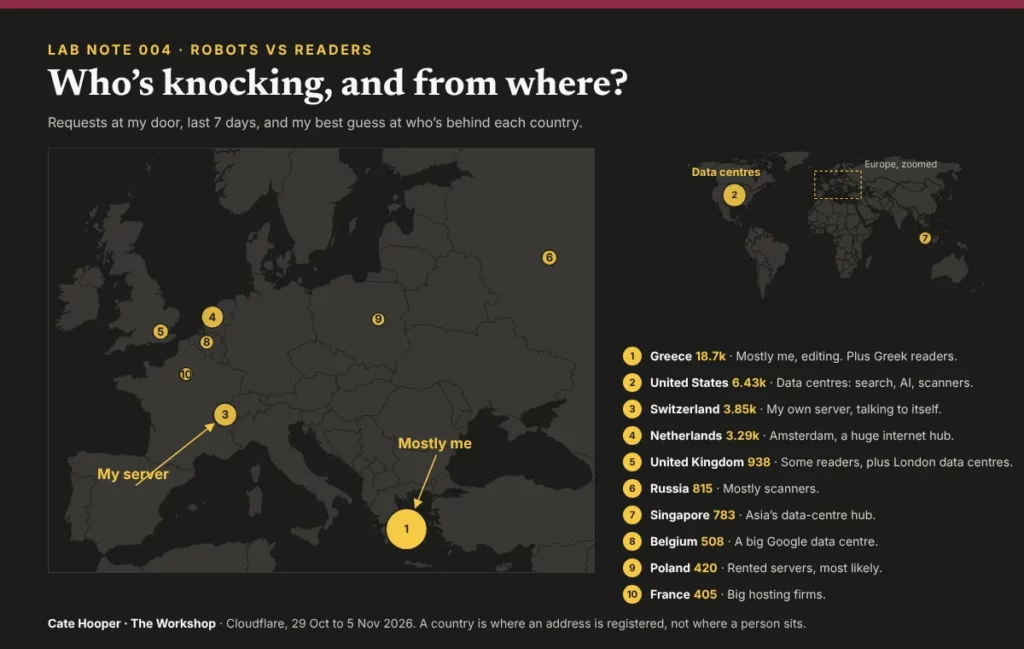
Cloudflare shows which country each request comes from. A country is where an internet address is registered, not where a person is sitting, so I can’t be certain. But the patterns are clear:
- Greece: mostly me. The door counts me even when the beacon doesn’t. Logged in, editing, previewing: every click is a request. Two Greek internet addresses, almost certainly mine, made over 17,700 requests in a week, most of them the editor saving these notes as I wrote.
- Switzerland: my own server. My host, Infomaniak, is Swiss, and WordPress calls its own address to run its scheduled jobs.
- United States, Netherlands, Singapore: data centres, which is where most bots live. The US is home to the big search engines and AI companies. Amsterdam and Singapore are huge internet hubs.
- Russia: most likely scanners, checking for weak spots.
- United Kingdom: probably some real readers, plus London’s data centres.
- Belgium, Poland, France: Belgium has a big Google data centre, and France has big hosting firms. Poland? Rented servers, most likely. I’m honestly not sure.
The same morning, I found my first ever comment.
I was so excited: someone had read my work and written back! It was in German, all about herb salt, with a link to a German funeral company’s website. A robot hoping for a free link. Crushing. What I did about it gets its own lab note.
The “page not found” errors weren’t mistakes.
In one week there were 1,650 requests for pages that don’t exist on my site. That’s mostly bots trying old WordPress login paths and settings files, hoping to find one left lying around.
Two challenges from Lithuania, and nobody passed.
When I checked how my login rule was doing, I found two challenges from Lithuania on 4 November. My first thought: that’s someone I know, who’d been looking at the site that day. But the rule’s solve rate says 0%: nobody passed the check. A person in a real browser usually sails through without even noticing. So it was most likely a bot that just happened to live in Lithuania.
The bouncer is calm. Out of 32,370 requests in a week, Cloudflare challenged or blocked just 165. Most bots aren’t breaking in. They’re just looking.
4 · The receipts
The real numbers, straight through the open door
- 1,930 of 2,110: requests from Canada in one day, all at my login page (one script, shamelessly guessing)
- 7,280 vs 132: page views at the door, against pages opened in real browsers (about 55 to 1)
- 32,370 requests at the door in 7 days (over half of them me, editing)
- 165 challenged or blocked (most bots just look)
- 1,650 requests for pages that don’t exist (bots trying doors that were never there)
- 1 security rule · 0 plugins (all done at the door)
5 · What I’d do differently
I’d chosen a really strong password when I set up WordPress, and I never share it anywhere. A strong password genuinely can’t be guessed the way the Canadian bot was trying. But seeing how determined these bots are (that on its own was a surprise, I must say), I thought: where there’s a will, there’s a way. Could a bot that never gives up find another way in? I didn’t want to find out. My password is only one lock. Now I have a second layer, the security rule, with Cloudflare as my door bouncer. But in hindsight, I should have put that second layer on from day one, not waited for the first bot to turn up and play knock-knock, who’s there with my site.
And writing this has got me thinking: maybe a third layer wouldn’t be a bad idea either. Just to be triply sure.
6 · What this means for your site
Most of the traffic to any website isn’t people, and that’s normal. Some of those bots are the reason people can find you at all. Three questions worth asking whoever runs your site: does my visitor count include bots? Is my login page guarded? And is xmlrpc.php still open?
The spec sheet
File
None. All set at Cloudflare’s door
Data from
Cloudflare: domain analytics, security analytics and Web Analytics, 29 Oct to 5 Nov 2026
Rule
“Protect login”: a Managed Challenge on wp-login.php and xmlrpc.php, from outside Greece
Privacy rule
Countries only. No internet addresses published, not even mine
Plugins added
None
Built with
Cloudflare’s free plan and one security rule