

THE CANARY • THE REAL-LIFE POV
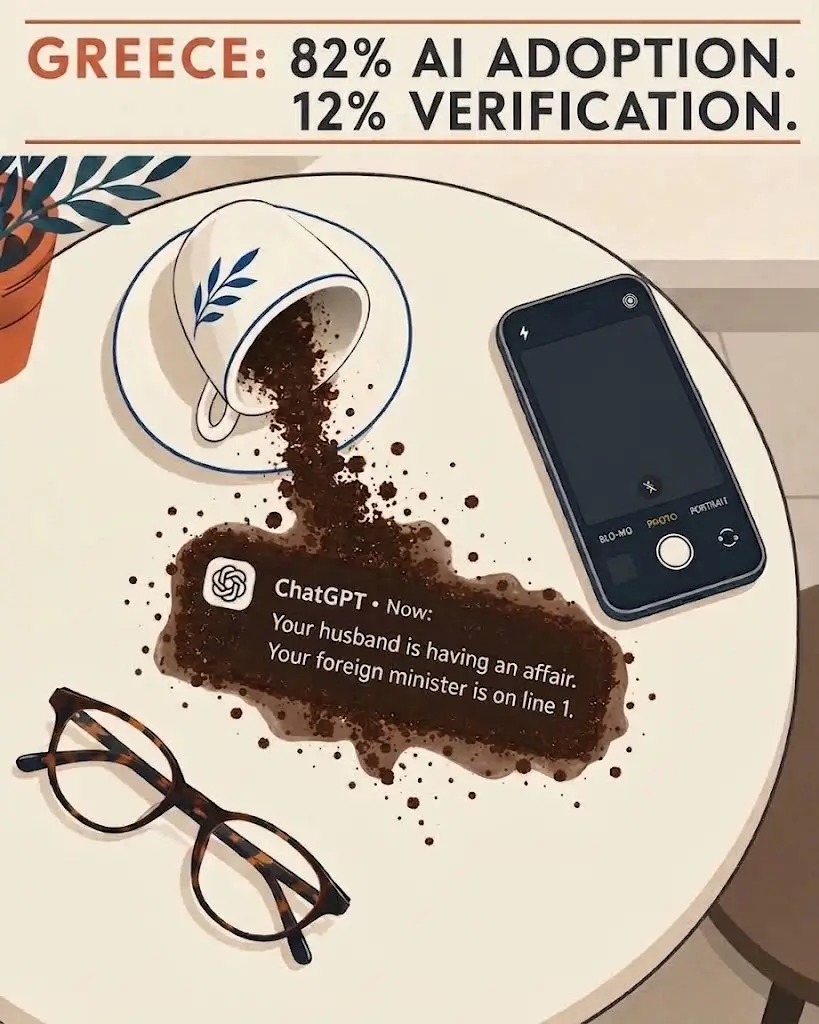
An Athenian woman photographed the dried grounds inside her husband’s coffee cup and uploaded the image to ChatGPT for an automated reading (kafemanteia). The model reported an affair with a woman whose name began with the letter “E”.
Bypassing any corroborating evidence, she accepted the output as fact and initiated divorce proceedings. Domestic media covered the incident as eccentric human interest. Yet it functioned as an unintentional stress test: when an interface answers with unhesitating certainty, critical scepticism vanishes.
Acting on synthetic output is simply an extreme demonstration of a wider impulse: treating machine confidence as a substitute for proof. It is the same uncritical reflex seen in Crete, where parents reportedly confronted university professors over grades on AI-generated coursework, right through to everyday family feeds where fabricated claims circulate without anyone checking if they are real.

THE ONION • THE OFFICIAL SPIN
Greece recorded the European Union’s lowest rate of exposure to online misinformation among all individuals surveyed at just 32.4% (against an EU average of 55.9%, and Ireland’s 82.8%).
— Eurostat (2025)Greece looks, at first glance, like Europe’s cleanest digital neighborhood. While eight in ten people in Ireland seem unable to unlock their phones without wading through digital disinformation, Greece registers barely a scratch.
Except Eurostat didn’t run forensic software or count fake stories. They simply asked: “Have you noticed anything untruthful or doubtful on the internet lately?”
The Greek responses tell quite a story when set against domestic polls. According to research by diaNEOsis, eight in ten Greeks report genuine dread over the spread of misinformation and the erosion of critical thinking. Yet when Eurostat asked how many people ever bother to open a second tab and check a primary source, fewer than 10% said yes. In Ireland, two-thirds do. The Irish aren’t uniquely targeted by lies; they simply have their eyes open.
Even Greece’s 16-to-29-year-olds flatline at 12% for checking sources. Quick thumbs and the ability to edit a reel in three seconds don’t translate into skepticism; they just mean swallowing bad information at double the speed. Disinformation in Greece rarely gets flagged because nobody is looking for it. An unverified claim gets nodded at, dropped into the family Viber group, or passed along on Instagram.
This passive habit looked harmless enough right up until the summer of 2026, when taking things at face value graduated into a national security debacle. An AI-assisted prank operation strolled cleanly past official vetting, straight into one of the most sensitive offices in the country:
THE OPEN DOOR • QUIET AGENCY
Uncritical trust in what we are shown doesn’t stay confined to social media. If the habit of verifying is absent at the base of a society, it is never going to survive at the top. All it takes is a recognisable voice, a plausible screen, and the comfortable assumption that someone else must have checked the credentials first.
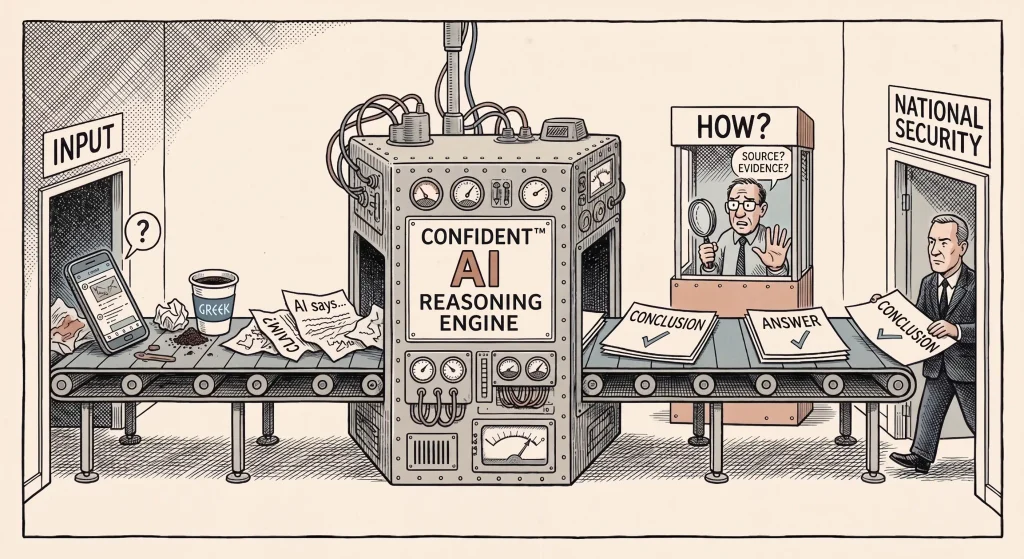
— Unverified machine output generated by Gemini, September 2026
From digital kafemanteia to national security: the conveyor belt of unearned confidence.
Sophisticated deception doesn’t always require a sophisticated defense—it just requires someone willing to pause, look up from the screen, and verify.
Over to you
I’m just a curious observer pulling on statistical threads and watching where they unspool. The 82% vs. 12% gap tells one story on paper, but the reality on our screens is usually quite a bit messier.
After realising how easily these models weave pure make-believe (where you have to actually call them out and ask if they just made it up), double-checking every single sentence gets exhausting. Maybe the answer is keeping the machine firmly caged—limiting it to small, grunt-work tasks where it doesn’t have free rein. Its results would be much easier to check. How do you use AI—any tips or tricks, or survivor prompts to cut straight to the heart of a task?
Don’t forget to cast your vote in the dispatch poll below, then drop your take in the comments—no accounts, no cookies. Join the conversation!
 PUBLIC POLL • WHAT’S YOUR VERDICT?
When an AI delivers an answer with total confidence, what is your default move?
Cast your vote.
👥 0 votes recorded so far
 OFF THE RECORD • UNTRACKED
THE DISPATCH DROP —
Slip Us a Lead
Heard an official figure that sounds like nonsense on the ground? Give us the lead. We’ll check the records—if it’s solid, it becomes our next post.
Stored locally in our queue. We never record IP addresses or digital fingerprints.
Primary Sources & Further Reading
The Dossier
[ Click to Inspect ]
 ↓
↓
The Dossier
[ Click to Inspect ]
↓
The Canary (Case Studies & Press)
- Vice: “Woman Files for Divorce After ChatGPT ‘Reads’ Husband’s Affair in Coffee Cup” (13 May 2025)
- LiFO: «Το πρώτο ελληνικό διαζύγιο λόγω Chat GPT που “λέει τον καφέ”» EL (24 April 2025)
- eKathimerini: “Professor in Crete confronted by student’s mother over AI exam failure” (24 February 2026)
- Reddit r/greece: “A small sample of how susceptible Greek society is to AI misinformation” Archived Facebook engagement on synthetic ‘120-year-old grandmother’ clickbait (33k likes, 5.6k comments).
The Exhibit (Institutional Incident)
- OECD AI Incidents Database: “AI-Driven Deepfake Attack Targets Greek National Security Advisor” (3 July 2026)
- eKathimerini: “Greek national security adviser targeted by Russian pranksters, opposition demands resignation” (3 July 2026)
The Raw Ledger (Datasets & Official Statistics)
-
Eurostat Data Explorer:
AI Adoption Among Youth (16–29)
isoc_ai_iaiu -
Eurostat Data Explorer:
Evaluating Data, Information and Digital Content
isoc_sk_edic_i21Misinformation exposure (Greece 32.4% vs. Ireland 82.8%) and source verification rates (fewer than 10% vs. 64% for all individuals 16–74; 12% vs. 78% for youth 16–29). - Eurostat Publication: “Being young in Europe today – Digital world”
- diaNEOsis: What do Greeks think about Artificial Intelligence? PDF • EL (March 2026)
The Deep Read (Behavioral Reading)
Grant, Adam. Think Again: The Power of Knowing What You Don’t Know. London: WH Allen, 2023.
On the cognitive hazard of effortless answers, overconfidence cycles, and why brilliant tools cannot compensate for the absence of critical verification.
The Commentary

What’s the most questionable thing you’ve let an AI convince you was true?
Zero cookies, no accounts, and no tracking. Drop a thought or story below.
Leave a Reply