 Built in The Workshop

The Short Read
One number, one story, step by step: the Canary, the Cage, the Onion and the Open Door. Then it’s over to you.

01 The Canary · The real-life view
So there I was, tapping away on the laptop. Today’s job: refresh my GDPR. I was after Alison’s free Get to Know GDPR course. I haven’t done it yet, but it’s apparently easy to follow. Real talk, not law talk, which is just what I wanted for a fast recap.
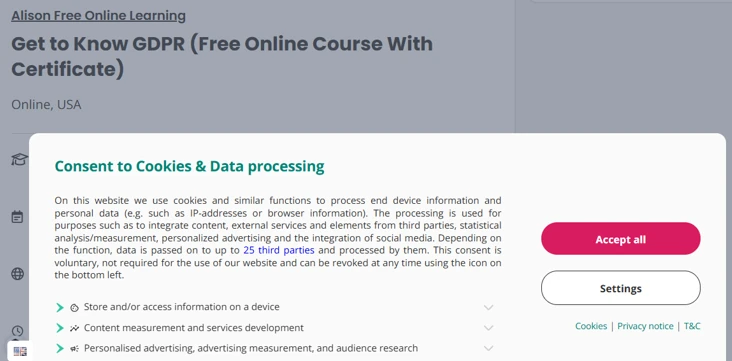
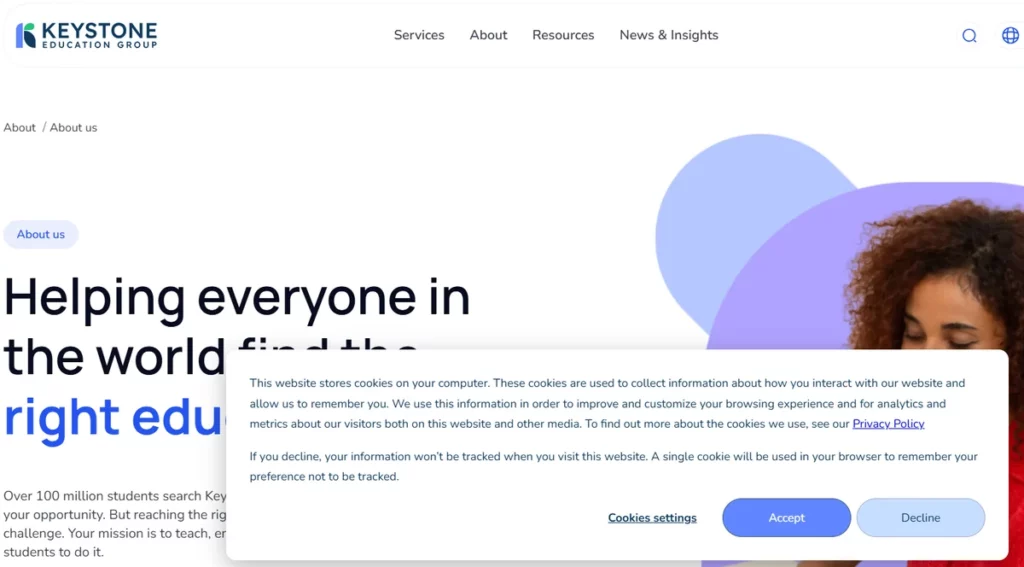
On the way I landed on educations.com, a course-listing site, to pick up the link. Up came the cookie banner. Grey wall, fine, expected.
Two buttons: Accept all and Settings. No Reject all. Still okay… click, Settings.
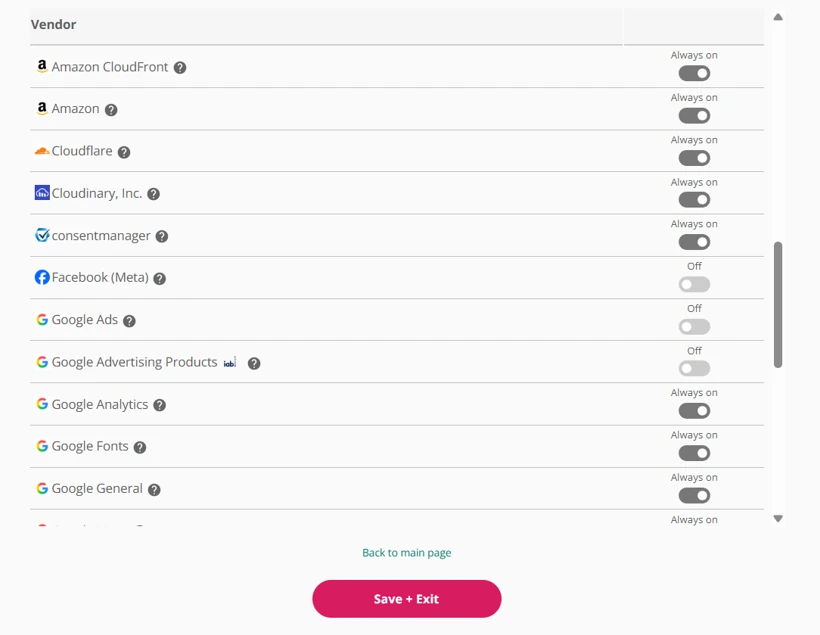
A sea of toggles washed into view. I leaned in to read the small print, and that’s when my irk-o-meter burst out of its box. Proper jack-in-the-box moment. I was bouncing in my seat.
Fourteen vendors were set to “Always on”. Locked. Toggle away as much as you like; they don’t budge. The rest were already off, so the only thing you could actually do was switch more on.
At the bottom sat a lovely rosy pink button: Save + Exit. No reject. Nothing to turn off. Anywhere.
And the owner? Educations.com belongs to Keystone Education Group, based just outside Oslo. By its own count it has more than 850 staff and a €100 million bond listed on Nasdaq Stockholm, and its business plan forecasts around USD 70–72 million in revenue this year.
This isn’t a two-person shop with a free plugin. It has the people and the money to get a cookie banner right. So here’s my accusation, and I’ll own it: this is a dark pattern, a design that steers you into a yes. Educations.com is Keystone’s site, and nobody else answers for what’s on it. Do I know what was in their heads? No. But at this size, I don’t believe it’s confusion.
To be clear: this banner was on educations.com, not on Alison’s own website. Alison didn’t build it, so please don’t blame Alison.
02 The Cage · The data
14 of 25
Up to 25 third parties on the banner’s own list. Fourteen locked “Always on”, with no way to switch them off.
The 14 locked on · strictly necessary?
| Vendor · job | Needed? |
|---|---|
| Google Analytics Counts visitors | No |
| Google Tag Manager Loads other tags | No |
| YouTube Video | Not yet |
| Google Maps Maps | Not yet |
| Google Fonts Fonts | Self-host |
| Unibuddy Student chat | Didn’t ask |
| Amazon Not explained | Unclear |
| Google General Not explained | Unclear |
| KeystoneAcademic Not explained | Unclear |
| Google reCAPTCHA Spam protection | Arguable |
| Amazon CloudFront Delivers pages | Probably |
| Cloudinary Delivers images | Probably |
| Cloudflare Security, traffic | Fair enough |
| Consentmanager Remembers your choice | Fair enough |

03 The Onion · The official spin
The official line · Not true
“Data is passed on to up to 25 third parties and processed by them. This consent is voluntary, not required for the use of our website and can be revoked at any time.”
Educations.com cookie banner, 2 November 2026
Voluntary, apparently. With one pink button, and it says Save + Exit.
Their words, not mine: “not required for the use of our website”. Then why is it locked on?
And no, I tried. There’s no way into that site without those fourteen switched on. If you find one, do tell me. Or meet the consent monster yourself (give it two seconds to pop up) on educations.com’s Get to Know GDPR page.
Welcome to Club Cookie
Let me tell a story to blow the cobwebs away, because this is where so many sites go wrong (most of them by accident).
Picture the website as a club. You don’t even want a big night out. You just want in.
On the door is ePrivacy Tracy, the bouncer. The real Tracy is good at her job. Before anyone sticks anything on you, she asks. Say no, and that’s that: nobody follows you in. The only ones she waves through without asking are the people the club can’t open without: the lighting tech, the cloakroom, security. Strictly necessary. Think Cloudflare’s security checks, which I use on this site too.
Plot twist. Tonight it isn’t the real Tracy on the door. It’s Doppelgänger Tracy. Same suit, same smile, same earpiece. But the club owners have broken her no. Her script straps her into a routine where anything you try registers as a “yes”, so she nods through every intrusion. There is no reject. No “no”.

“Settings” just leads to more ways to say yes.
Meanwhile the queue is long, the music’s thumping, and nobody’s reading small print in the cold. So you press whatever makes the banner go away and get in. Consent fatigue and manipulation, in a blink.
Inside, the vendors swarm the dance floor, snapping wristbands on everyone (tracking cookies). They follow your moves across the floor, shovelling up data like a forever-hungry giant.
Patrolling the floor is GDPR Bobby, the club manager, pinky-promise clipboard in hand. His job is what happens to the data: kept safe, used only for what was agreed, and not passed round the bar. Catch a vendor misbehaving, and Bobby is a scary dude. Dragged out by their earlobes, with a fine and a bruised ego to boot. And he doesn’t only look at the vendors. The club owner answers for it too.
Here’s what gives Bobby a corker of a headache. Tracy and Bobby share one rulebook, and a yes only counts if a no was just as easy. Fake Tracy never offered a no, so there was never a real yes.
The real Tracy respects a no instantly. The fake one can’t even say it.
The rulebook for educations.com: Keystone Education Group is registered in Norway. Not in the EU, but it doesn’t matter: Norway is in the EEA, so GDPR applies just the same.
Tracy’s rule comes from Article 5(3) of the EU ePrivacy Directive: ask before storing or reading anything on someone’s device, unless it’s strictly necessary for a service they asked for. Norway’s flavour of it is § 3-15 of its Electronic Communications Act, tightened on 1 January 2025. The consent part is policed by the data protection authority, Datatilsynet, and the rest by the communications authority, Nkom.
Datatilsynet’s guidance is blunt: saying no mustn’t take extra clicks. If “Accept all” is on the first screen, rejecting should be just as easy, right there.
Educations.com consent banner = fail.
A side note, to put some furniture in the privacy cloakroom. The European rulebook isn’t identical everywhere. ePrivacy is a directive, not a regulation, so each country writes its own version into national law. For a feel of how they line up, look at the EU regulators’ cookie banner taskforce report from January 2023.
Most authorities on the taskforce treat a banner with no way to refuse, on any layer with an accept button, as invalid consent. Most also want the reject on the first screen. Spain was the famous holdout, and it changed its rules in July 2023 to require one there too. This banner has no reject on any screen, so we really don’t need to look any further.
Will educations.com get fried by its regulator? They wouldn’t be the first. They could join the club:
Exhibit
France’s regulator fined Google and Facebook €210 million between them, because accepting cookies took one click and refusing took several. Google’s own tools are among the ones locked on here.
CNIL decisions, January 2022
Incident file
| Regulator | CNIL (France) |
| Sites | google.fr, youtube.com, facebook.com |
| Problem | One click to accept, several to refuse |
| Fines | Google €150m, Facebook €60m |
| Extra | €100,000 a day if not fixed in 3 months |
| Status | Decided (6 January 2022) |
04 The Open Door · Quiet agency
Does this banner fall short of what regulators say? Yes. Whether it’s illegal is for a regulator or a court to rule. But whose it is isn’t in doubt: it’s Keystone’s banner, on Keystone’s site.
Meanwhile, you don’t have to stay stuck behind the grey wall. Here’s what you can do:
- Look past the first screen. If there’s no Reject all, try Settings, Manage or Options. A proper reject is sometimes hiding there.
- Walk round it. If there’s no way to say no, leave. I could have gone straight to Alison’s own site for the course.
- Let your browser help. Turn on its tracking protection, and clear cookies after a visit you didn’t get a say in.
- Know you can complain. Every EU and EEA country has a regulator: Datatilsynet in Norway, the ICO in the UK, the Hellenic Data Protection Authority here in Greece.
The bottom line
A GDPR course, behind a banner that won’t take no for an answer.
A real choice has two doors of the same size. If you can only find one, it isn’t a choice.

05 The Song · Over to you
So many banners are built wrong out of ignorance, not intent. Small and medium site owners stick one on and genuinely try to do it right, in a murky field, with busy lives, no decent template and plenty of bad examples around them to copy. I’ve a lot of time for those people.
Not this one. Keystone listed every vendor, very transparently, then gave me no way to say no to fourteen of them. Toggles don’t lock themselves. Somebody set them to “Always on”, and somebody left the no out. It’s their site, their banner, their pink button, so it’s their responsibility. I’m not here to say what the punishment should be. But I’m not going to pretend it’s an accident either.
And here’s the kicker. Pop over to Keystone’s own corporate site, keg.com, the one universities and investors see, and the banner there has a Decline button, right on the first screen. It even explains what declining does. So they know how to offer a no. They just don’t offer one to the students on educations.com.
Oh, and this site, Canary&Onion, has no cookie banner at all. Not because I forgot one. There’s simply nothing here that needs to knock.
Cast your vote below, then tell me in the comments. No accounts, no cookies.
Over to you
What’s your verdict?
A big site locks trackers on and gives you no reject button. What's your move?
Tap an answer to vote. Anonymous, no cookies.
One tap, no cookies, no account. Then see how everyone else voted.
See every verdict →The Dossier · Primary sources
The Canary (The banner)
- Alison: “Get to Know GDPR” (free, CPD-accredited, beginner level; learner reviews on the course page)
- Educations.com: “Get to Know GDPR: free online course with certificate” (course listing; banner seen 2 November 2026)
- Keystone Education Group: “About Keystone Education Group” (accessed November 2026)
- Nasdaq: Keystone Education Group company announcement (staff numbers: “more than 850+ employees worldwide”)
- Keystone Education Group: “Investor Relations” (Nasdaq Stockholm bond listing; accessed November 2026)
- The PIE News: “Keystone reports 10% drop in Q2 revenue amid UK, US recruitment pressures” (30 September 2026)
- Cision: “Keystone Academic Solutions and Educations Media Group announce merger” (23 June 2021)
The Exhibit (Enforcement)
- SCL: “French data protection regulator fines Google and Facebook for making it harder to refuse cookies than to accept them” (11 January 2022)
- PrivacyLaws: “CNIL fines Google €150 million and Facebook €60 million” (January 2022)
The Raw Ledger (Rules & Regulators)
- EUR-Lex: Directive 2002/58/EC (ePrivacy Directive), Article 5(3)
- EDPB: “Report of the work undertaken by the Cookie Banner Taskforce” PDF (17 January 2023)
- Legal247: “Cookie consent” (Norwegian rules from 1 January 2025)
- Legiscope: «Cookies i Norge: kontroller nettstedet etter ekomloven § 3-15» NO
- Linklaters: “Spanish data regulator changes approach and requires a reject button in cookie banners” (July 2023)
The Deep Read (Background)
- SVW: “CJEU Fashion ID case: Joint controllership for Facebook like buttons” On why the website that embeds a third party’s tool shares responsibility for what it collects.
- SVW: “New Ecom Act – important changes effective from 1 January 2025” On Norway’s move from browser-setting consent to full GDPR-standard consent.
Community Dispatch
The Commentary
What’s the worst cookie banner you’ve met lately?
Answer the question, share a story, or just tell me what you thought.
Zero cookies, no accounts, no tracking.
-
B
Such a good read! Love your writing style.
-

Thank you, Barbara! So happy to e-meet you, and so glad you enjoyed it. If you like quick reads, Mr Smith shorts comes with audio too, read by me, perfect for a coffee break or a spare ten minutes. I’d love to know if it lands well. Have a lovely day!
Leave a Reply